Olive oil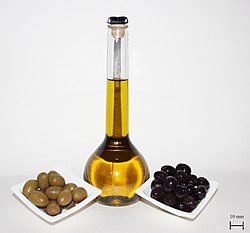 Extra virgin olive oil presented with green and black preserved table olives |
| Fat composition |
|---|
| Saturated fats |
|---|
| Total saturated | Palmitic acid: 13.0%
Stearic acid: 1.5% |
|---|
| Unsaturated fats |
|---|
| Total unsaturated | > 85% |
|---|
| Monounsaturated | Oleic acid: 70.0%
Palmitoleic acid: 0.3–3.5% |
|---|
| Polyunsaturated | Linoleic acid: 15.0%
α-Linolenic acid: 0.5% |
|---|
| Properties |
|---|
| Food energy per 100 g (3.5 oz) | 3,700 kJ (880 kcal) |
|---|
| Melting point | −6.0 °C (21.2 °F) |
|---|
| Boiling point | 700 °C (1,292 °F) |
|---|
| Smoke point | 190–215 °C (374–419 °F) (extra virgin)
175 °C (347 °F) (virgin)
210 °C (410 °F) (refined) |
|---|
| Solidity at 20 °C (68 °F) | Liquid |
|---|
| Specific gravity at 20 °C (68 °F) | 0.911 |
|---|
| Viscosity at 20 °C (68 °F) | 84 cP |
|---|
| Refractive index | 1.4677–1.4705 (virgin and refined)
1.4680–1.4707 (pomace) |
|---|
| Iodine value | 75–94 (virgin and refined)
75–92 (pomace) |
|---|
| Acid value | maximum: 6.6%(refined and pomace)
0.8% (extra virgin) |
|---|
| Saponification value | 184–196 (virgin and refined)
182–193 (pomace) |
|---|
| Peroxide value | 20 (virgin)
10 (refined and pomace) |
|---|
Olive oil is a liquid fat obtained from olives (the fruit of Olea europaea; family Oleaceae), a traditional tree crop of the Mediterranean Basin, produced by pressing whole olives and extracting the oil. It is commonly used in cooking, for frying foods or as a salad dressing. It is also used in cosmetics, pharmaceuticals, and soaps, and as a fuel for traditional oil lamps, and has additional uses in some religions. The olive is one of three core food plants in Mediterranean cuisine; the other two are wheat and grapes. Olive trees have been grown around the Mediterranean since the 8th millennium BC.
The top five producers of olive oil by volume are Spain, Morocco, Turkey, Greece, and Italy. Per capita consumption is highest in Greece, followed by Spain and Italy.
The composition of olive oil varies with the cultivar, altitude, time of harvest and extraction process. It consists mainly of oleic acid (up to 83%), with smaller amounts of other fatty acids including linoleic acid (up to 21%) and palmitic acid (up to 20%). Extra virgin olive oil is required to have no more than 0.8% free acidity and is considered to have favorable flavor characteristics.
Olive oil has long been a common ingredient in Mediterranean cuisine, including ancient Greek and Roman cuisine. Wild olives, which originated in Asia Minor, were collected by Neolithic people as early as the 8th millennium BC. Besides food, olive oil has been used for religious rituals, medicines, as a fuel in oil lamps, soap-making, and skin care application. The Spartans and other Greeks used oil to rub themselves while exercising in the gymnasia. From its beginnings early in the 7th century BC, the cosmetic use of olive oil quickly spread to all of the Hellenic city states, together with athletes training in the nude, and lasted close to a thousand years despite its great expense.
Symbolism and mythology
Olive crusher (trapetum) in Pompeii (79 AD)
The olive tree has historically been a symbol of peace between nations. It has played a religious and social role in Greek mythology, especially concerning the name of the city of Athens where the city was named after the goddess Athena because her gift of an olive tree was held to be more precious than rival Poseidon's gift of a salt spring.
The_Manufacture_of_Oil_drawn_and_engraved_by_J_Amman_in_the_Sixteenth_Century
Uses
Culinary use
Olive oil is an important cooking oil in countries surrounding the Mediterranean, and it forms one of the three staple food plants of Mediterranean cuisine, the other two being wheat (as in pasta, bread, and couscous) and the grape, used as a dessert fruit and for wine.
Extra virgin olive oil is mostly used as a salad dressing and as an ingredient in salad dressings. It is also used with foods to be eaten cold. If uncompromised by heat, the flavor is stronger. It also can be used for sautéing.
When extra virgin olive oil is heated above 210–216 °C (410–421 °F), depending on its free fatty acid content, the unrefined particles within the oil are burned. This leads to deteriorated taste. Refined olive oils are suited for deep frying because of the higher smoke point and milder flavour. Extra virgin oils have a smoke point around 180–215 °C (356–419 °F),[1] with higher-quality oils having a higher smoke point, whereas refined light olive oil has a smoke point up to 230 °C (446 °F). It is a "popular myth" that high-quality extra virgin olive oil is a poor choice for cooking, as its smoke point is above the temperatures required for cooking, and has greater resistance to oxidation than most other cooking oils, as a result of its antioxidant and mono-unsaturated fat content.
Choosing a cold-pressed olive oil can be similar to selecting a wine. The flavor of these oils varies considerably and a particular oil may be more suited for a particular dish.
Fresh oil, as available in an oil-producing region, tastes noticeably different from the older oils available elsewhere. In time, oils deteriorate and become stale. One-year-old oil may be still pleasant to the taste, but it is less fragrant than fresh oil. After the first year, olive oil is more suitable for cooking than serving raw.
Religious use
Christianity
The Roman Catholic, Orthodox and Anglican churches use olive oil for the Oil of Catechumens (used to bless and strengthen those preparing for Baptism) and Oil of the Sick (used to confer the Sacrament of Anointing of the Sick or Unction). Olive oil mixed with a perfuming agent such as balsam is consecrated by bishops as Sacred Chrism, which is used to confer the sacrament of Confirmation (as a symbol of the strengthening of the Holy Spirit), in the rites of Baptism and the ordination of priests and bishops, in the consecration of altars and churches, and, traditionally, in the anointing of monarchs at their coronation.
Eastern Orthodox Christians still use oil lamps in their churches, home prayer corners and in the cemeteries. A vigil lamp consists of a votive glass containing a half-inch of water and filled the rest with olive oil. The glass has a metal holder that hangs from a bracket on the wall or sits on a table. A cork float with a lit wick floats on the oil. To douse the flame, the float is carefully pressed down into the oil. Makeshift oil lamps can easily be made by soaking a ball of cotton in olive oil and forming it into a peak. The peak is lit and then burns until all the oil is consumed, whereupon the rest of the cotton burns out. Olive oil is a usual offering to churches and cemeteries.
Judaism
In Jewish observance, olive oil was the only fuel allowed to be used in the seven-branched menorah in the Mishkan service during the Exodus of the tribes of Israel from Egypt, and later in the permanent Temple in Jerusalem. It was obtained by using only the first drop from a squeezed olive and was consecrated for use only in the Temple by the priests and stored in special containers. In modern times, although candles can be used to light the menorah at Hanukkah, oil containers are preferred, to imitate the original menorah.Olive oil was also used to prepare the holy anointing oil used for priests, kings, prophets, and others.
Skin care
One study found that olive oil lowered the risk of dermatitis for infants in all gestational stages when compared with emollient cream, while another study of adults found that topical treatment with olive oil "significantly damages the skin barrier" when compared to sunflower oil, and that it may make existing atopic dermatitis worse. The researchers concluded that due to the negative outcome in adults, they do not recommend the use of olive oil for the treatment of dry skin and infant massage. Applying olive oil to the skin does not help prevent or reduce stretch marks.
Other
Olive oil is also a natural and safe lubricant, and can be used to lubricate kitchen machinery (grinders, blenders, cookware, etc.). It can also be used for illumination (oil lamps) or as the base for soaps and detergents. Some cosmetics also use olive oil as their base, and it can be used as a substitute for machine oil.
The Ranieri Filo della Torre is an international literary prize for writings about extra virgin olive oil. It yearly honors poetry, fiction and non-fiction about extra virgin olive oil.
10 Facts About Olive Oil
- Greece is the world’s third largest producer of olive oil and the world’s largest exporter of extra virgin olive oil. Its extra virgin olive oil is so good that it is exported even to countries such as Italy and Spain.
- Olive oil is extremely high in oleic acid which is used to reduce blood pressure. Olive oil also contains many antioxidants including vitamin E, carotenoids and oleuropein.
- Extra virgin olive oil comes from the first pressing of the olives with no chemicals used to extract the oil. This means it has a wonderful, fresh, clean taste.
- Olive oil is believed to have a protective effect against a variety of cancers, including breast, prostate, endometrium and digestive tract.
- The fresher the olive oil, the better the taste. After a year or so, oil is best used for cooking and fresh oil used for salad dressings and other cold uses.
- Olive oil has a higher proportion of monounsaturated fats than animal fat, which is often high in saturated fat. Studies have indicated that if you replace saturated fats with monounsaturated fats, you can lower your risk of coronary heart disease.
- Because oil flows from the olives naturally when they are crushed, the vitamins and natural ingredients are not destroyed with chemicals and preservatives.
- Greek people eat an average of 26 litres of olive oil each every year!
- Studies have shown that olive oil reduces bad cholesterol (LDL) and increases levels of good cholesterol (HDL).
- One olive tree can produce around four litres of oil every year for hundreds of years.